The African Development Bank (AfDB) says Malawi’s push to use public-private partnerships (PPPs) to finance infrastructure development is failing to attract the private capital needed to close major infrastructure and social-sector financing gaps,.
Data contained in the 2026 AfDB Country Focus Report shows that PPPs financing in Malawi accounts for less than 0.1 percent of gross domestic product (GDP), compared with a 4.2 percent average for sub-Saharan Africa.
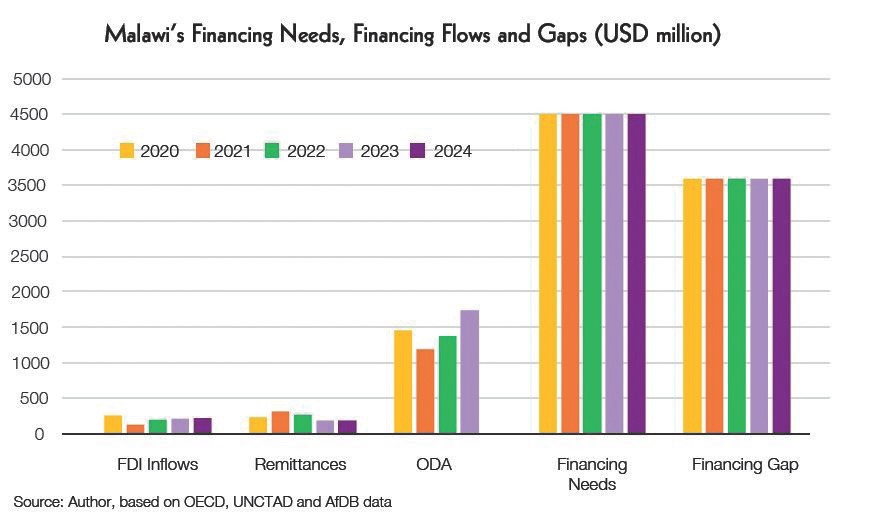
This comes as donor dependence has deepened, with AfDB data showing that 60 percent of social spending externally financed amid a projected 26 percent decline in aid inflows by 2026 with the economy losing $400 million (about K700 billion) to illicit financial flows annually.
According to AfDB, Malawi faced estimated development financing needs of $4.5 billion (about K8 trillion) and an annual financing gap of about $3.59 billion (about K6 trillion).
In health, per capita spending is just $40, well below the World Health Organisation’s recommended minimum of $86 for basic services under the National Health Financing Strategy for Malawi 2023–2030.
For energy, the World Bank estimates that $5.5 billion (about K9.6 trillion) is needed to raise access to 70 percent by 2030.
The transport sector requirements are similarly high, at about $9.15 billion (about K16 trillion), while education financing remains below the United Nations’ recommended 15–20 percent of the national budget.
Reads the report in part: “Malawi’s legal, institutional and technical frameworks supporting PPP development has improved significantly following the enactment of PPP Act No. 23, 2022.
“However, the overall environment faces substantial challenges in implementation due to the high-risk investment climate, high debt levels, and a lack of experience in complex contract negotiations.”
The amended PPP Act allows for government-identified and solicited projects, with the former going through competitive bidding, while also allowing for the constitution of special-purpose vehicles.
The AfDB says strengthening domestic resource mobilisation is therefore critical, observing that Malawi’s first Malawi Implementation Plan targeted annual revenue growth of five percent, but actual revenue growth averaged only 1.6 percent over the past decade, against expenditure growth of 4.6 percent.
The revenue shortfall has increasingly been financed through debt, with banks holding about 65 percent of government paper, thereby crowding out private-sector financing, while Malawi’s tax-to-GDP ratio stood at only 14.2 percent in 2025/26, reflecting a narrow tax base and weak tax buoyancy.
Scotland-based Malawian economist Velli Nyirongo said the aid shock exposes long-standing structural weaknesses in economies such as Malawi that have historically relied on external support to finance both development and recurrent spending.
“At the same time, the government’s limited fiscal space reduces its capacity to absorb or offset this change without difficult trade-offs,” he said.
Speaking during the PPP Bankability and Project Readiness Executive Workshop recently, Public Private Partnership Commission chief executive officer Arthur Nanthuru said the commission is witnessing increasing interest in PPP opportunities from both public and private sectors.
“The challenge before us is no longer in identifying projects, but ensuring that those projects are properly prepared and investment-ready,” he said.